How AI is Revolutionizing the Home Inspection Response for Real Estate Agents
Podcast Overview
Introduction
For real estate agents, the home inspection contingency is one of the most critical and high-stakes phases of any transaction. It’s where a buyer’s dream meets a property’s reality, and where your skills as an advisor and negotiator are put to the ultimate test. However, this period is also a notorious operational bottleneck, bogged down by complexity, client anxiety, and tedious administrative work.
The culprit? A dense, 50+ page inspection report filled with technical jargon, a mix of major and minor issues, and the potential to overwhelm even the most level-headed client. Your job is to translate this document, strategize a response, and negotiate effectively all while managing client emotions and protecting their interests.
But what if this entire high-friction process could be transformed from a time-consuming burden into a powerful strategic advantage? This post explores how specialized, vertical AI is not just changing the game it's creating a new one altogether, allowing you to master the home inspection response in minutes, not hours.
The Traditional Inspection Response: A High-Friction Bottleneck
Before we dive into the solution, it's essential to understand the core challenges that have made the inspection response process so difficult for so long. For decades, agents have navigated this minefield manually, a process that consumes time, creates stress, and carries significant liability.
The Overwhelming Report & The Burden of Translation
The modern home inspection report is a formidable document. It’s designed to be comprehensive, but for a homebuyer, its technical language can turn a tool for due diligence into a source of alarm. As the agent, you are thrust into the role of interpreter-in-chief.
You must:
- Decode Jargon: Explain the difference between a "GFCI outlet" and a "reversed polarity" issue.
- Prioritize Findings: Distinguish between a critical safety concern, like a faulty furnace, and a minor cosmetic flaw, like a squeaky floorboard.
- Manage Client Anxiety: Guide buyers away from "nit-picking" small issues while ensuring they understand the gravity of significant defects.
This advisory role is a cornerstone of your value, but it's also where misinterpretations can lead to serious financial and legal repercussions.
The High-Stakes Negotiation Dance
Once you and your client have reviewed the report, the next step is crafting a formal response. This negotiation is a delicate dance. A poorly written or overly demanding repair request addendum can quickly erode goodwill, transforming a collaborative discussion into an adversarial confrontation that can kill the deal.
The core of the problem is information asymmetry. The buyer sees a long list of defects and feels compelled to ask for everything, while the seller may view the requests with suspicion, believing it's an attempt to renegotiate the price. You're caught in the middle, trying to bridge this gap with a clear, reasonable, and data-backed request.
The Ultimate Time Sink
Beyond the strategic challenges, the manual process is a profound time sink. Meticulously reading the report, cross-referencing findings with photos, researching potential repair costs, aligning with your client, and drafting a legally sound addendum can take hours for a single transaction.
This is valuable time stolen from client acquisition, marketing, and other high-value, revenue-generating activities. Across multiple deals, this administrative drain significantly impacts your productivity and capacity for growth.
The Solution: How Vertical AI Streamlines the Entire Workflow
To solve these deep, industry-specific challenges, a new category of software has emerged. These platforms use vertical AI artificial intelligence tailored specifically for the real estate industry to automate and enhance the entire inspection response workflow. They turn the cumbersome inspection PDF into a strategic negotiation asset.
Here’s how a platform like InspectionResponse.com breaks down the process:
Step 1: Instant Clarity from a Complex PDF
The workflow begins the moment you upload the inspection report. The AI engine conducts a comprehensive analysis that goes far beyond simple text recognition.
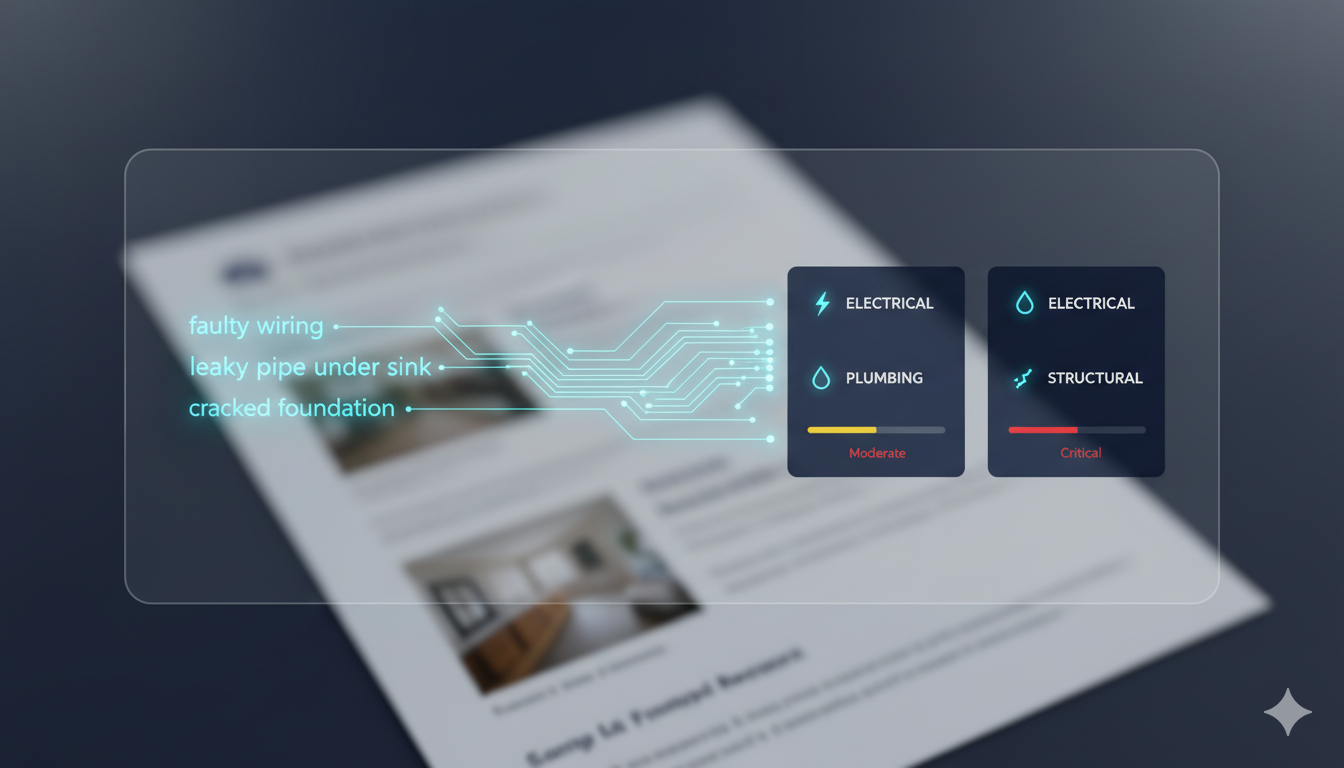
- It Decodes Jargon: Complex technical terms are instantly translated into clear, easy-to-understand language, demystifying the findings for you and your client.
- It Pinpoints Key Issues: The system intelligently identifies and categorizes every defect and observation, allowing you to immediately focus on the most important items.
- It Extracts Evidence: Crucially, the AI automatically links each finding to the corresponding photo and page number in the original report. This creates undeniable visual proof for every request, forming the foundation of a data-driven negotiation.
Step 2: From Analysis to Actionable Strategy
Once the report is parsed, the platform shifts from analysis to strategic counsel, acting as your AI co-pilot.
- It Provides Data-Driven Repair Estimates: A cornerstone feature is the generation of cost and time estimates for each issue. It provides a range for repairs by a professional contractor and an estimate for a potential DIY approach. This empowers you and your client to instantly quantify the financial impact, differentiating a "$200 fix from a $10,000 problem" and providing massive negotiating leverage.
- It Delivers Expert-Level Recommendations: The AI co-pilot delivers strategic advice for each finding, explaining the "why" behind its recommendations. It helps you decide whether to request a repair, ask for a credit, or simply note an issue for future monitoring, turning hours of deliberation into seconds of confirmation.
Step 3: Automated, Professional Document Generation
This final stage is a game-changer. After you've selected your desired items and strategy, the system automates the creation of all necessary documents.
- It Crafts Professional Language: With a single click, the platform generates professionally crafted, legally sound repair request language for each item. This language is fully customizable to suit any negotiation style.
- It Builds an Authoritative Addendum: The system compiles all your requests into a clean, irrefutable addendum. This document automatically embeds the photo evidence and page number references, creating a polished, persuasive response that impresses sellers and their agents and facilitates a smoother negotiation.
How InspectionResponse.com Transforms Your Business
By leveraging vertical AI, InspectionResponse.com directly tackles the friction, time sinks, and potential liability of the traditional inspection response. Instead of spending hours deciphering jargon and manually typing up repair requests, you can transform any inspection report into a complete, professional, and strategic response in minutes.
Our platform’s smart analysis instantly identifies and organizes findings, while the AI co-pilot provides the cost estimates and strategic advice you need to guide your clients with confidence. The one-click generation of a photo-embedded repair addendum not only saves you immense time but also elevates your professionalism, strengthens your negotiating position, and helps protect you from potential liability.
You move from being an interpreter of a confusing document to a high-level strategist armed with data. This allows you to provide a superior client experience, close deals more efficiently, and reclaim your time to focus on growing your business.
Conclusion
The home inspection contingency no longer has to be a source of friction and frustration. With the right tools, it can become the moment where you deliver the most value to your clients. By embracing vertical AI, you can eliminate the administrative burden, mitigate risk, and position yourself as a tech-forward, strategic advisor. It’s time to turn one of the biggest bottlenecks in real estate into your greatest competitive advantage.
Ready to see how it works? Try InspectionResponse.com today and streamline your next deal.
Additional Resources
Briefing Document & Key Takeaways
AI Transformation of the Real Estate Home Inspection Response
Executive Summary
The home inspection contingency phase in real estate transactions represents a critical yet operationally inefficient bottleneck for agents. The traditional process involves manually deciphering dense, technical inspection reports, managing client anxiety, and engaging in high-stakes negotiations, all of which consumes significant time and carries potential liability. A new category of vertical AI platforms, specifically designed for the real estate industry, is transforming this high-friction process. By automating the analysis of inspection reports, these tools instantly translate jargon, categorize findings, and provide data-driven repair cost estimates. This enables agents to shift from being interpreters of complex documents to high-level strategists. The AI-powered workflow culminates in the one-click generation of professional, evidence-backed repair addendums, fundamentally changing the negotiation dynamic. This technological shift saves agents hours per transaction, enhances their professional standing, mitigates risk, and turns a notorious administrative burden into a significant competitive advantage.
--------------------------------------------------------------------------------
1. The Traditional Inspection Response: A High-Friction Bottleneck
The home inspection response process has long been identified as a primary source of complexity, stress, and inefficiency for real estate agents. This phase, while crucial for due diligence, is hampered by several core challenges that create a significant operational bottleneck.
1.1 The Overwhelming Report and the Burden of Translation
The modern home inspection report is a formidable document, often exceeding 50 pages and filled with technical jargon. While intended to be comprehensive, its complexity can be a source of alarm for homebuyers. This places the real estate agent in the role of "interpreter-in-chief," with key responsibilities including:
• Decoding Jargon: Agents must explain technical terms and their implications, such as the difference between a "GFCI outlet" and a "reversed polarity" issue.
• Prioritizing Findings: A critical task is to help clients distinguish between significant safety or structural concerns (e.g., a faulty furnace) and minor cosmetic flaws (e.g., a squeaky floorboard).
• Managing Client Anxiety: Agents must guide clients away from "nit-picking" minor issues while ensuring they fully grasp the gravity of major defects. This advisory role is central to an agent's value but is fraught with the risk of misinterpretation, which can lead to severe financial and legal repercussions.
1.2 The High-Stakes Negotiation Dance
Following the report review, the agent must craft a formal repair request addendum. This negotiation is described as a "delicate dance," where a poorly formulated request can erode goodwill and escalate a collaborative discussion into an adversarial conflict capable of terminating the deal. The central problem is information asymmetry:
• The Buyer's Perspective: Faced with a long list of defects, the buyer may feel compelled to request repairs for every item.
• The Seller's Perspective: The seller might view extensive requests with suspicion, interpreting them as an attempt to renegotiate the purchase price.
The agent is positioned in the middle, tasked with bridging this gap by presenting a clear, reasonable, and data-supported request.
1.3 The Administrative Time Sink
Beyond the strategic difficulties, the manual process is a "profound time sink." The typical workflow which includes meticulously reading the report, cross-referencing findings with photos, researching potential repair costs, aligning with the client, and drafting a legally sound addendum—can consume hours for a single transaction. This administrative drain detracts from time that could be spent on high-value, revenue-generating activities such as client acquisition and marketing, thereby limiting an agent's productivity and capacity for business growth.
2. The Solution: Vertical AI for Workflow Streamlining
To address these industry-specific challenges, specialized vertical AI platforms have been developed. These systems are tailored specifically for real estate workflows, automating and enhancing the entire inspection response process. A platform like InspectionResponse.com is cited as an example that transforms a cumbersome inspection report PDF into a strategic negotiation asset.
3. The AI-Powered Three-Step Workflow
The AI-driven process is structured to convert complex information into a clear, actionable strategy in a fraction of the time required by manual methods.
Step 1: Instant Clarity from a Complex PDF
The workflow begins upon uploading the inspection report PDF. The AI engine performs a comprehensive analysis that includes:
• Jargon Translation: Technical terms are instantly translated into simple, easy-to-understand language for both the agent and their client.
• Issue Identification: The system intelligently identifies, extracts, and categorizes every defect and observation from the report, allowing for immediate focus on the most critical items.
• Evidence Extraction: The AI automatically links each identified issue to its corresponding photograph and page number in the original report, creating a foundation of undeniable visual proof for subsequent negotiations.
Step 2: From Analysis to Actionable Strategy
Once the report is parsed, the platform functions as an "AI co-pilot," shifting from analysis to providing strategic counsel. Key features of this stage include:
• Data-Driven Repair Estimates: The system generates cost and time estimates for resolving each issue, providing a range for professional contractor work as well as an estimate for a potential DIY approach. This empowers the agent and client to quantify the financial impact and differentiate a "$200 fix from a $10,000 problem," providing significant negotiating leverage.
• Expert-Level Recommendations: The AI co-pilot delivers strategic advice for each finding, explaining the rationale behind its recommendations. It assists in deciding whether to request a repair, ask for a credit, or simply note an issue for future monitoring.
Step 3: Automated, Professional Document Generation
The final stage automates the creation of all necessary response documents. After the agent selects the desired items and strategy, the system:
• Crafts Professional Language: With a single click, it generates professionally worded, legally sound repair request language for each item, which remains fully customizable.
• Builds an Authoritative Addendum: The platform compiles all selected requests into a clean, polished, and persuasive addendum. This document automatically embeds the photo evidence and page number references for each item, creating an irrefutable response that facilitates a smoother negotiation.
4. Transformative Business Impacts
The adoption of vertical AI for inspection responses offers a range of direct benefits that transform an agent's business operations and strategic positioning.
Efficiency and Time Savings
Reduces a multi-hour manual process to a matter of minutes, freeing up agent time for business development and client-facing activities.
Enhanced Negotiating Power
Arms the agent with data-driven cost estimates and photo-embedded evidence, strengthening their negotiating position and fostering more collaborative discussions.
Elevated Professionalism
Generates polished, authoritative, and persuasive documents that impress clients, sellers, and opposing agents.
Superior Client Experience
Demystifies the inspection report, reduces client anxiety, and provides clear, data-backed guidance with confidence.
Risk Mitigation
Helps protect the agent from potential liability associated with misinterpreting reports or drafting incomplete addendums.
Strategic Repositioning
Shifts the agent's role from a manual "interpreter of a confusing document to a high-level strategist armed with data," positioning them as a tech-forward, strategic advisor.
By leveraging these tools, the home inspection contingency can be converted from a source of friction into an opportunity for agents to deliver maximum value to their clients, ultimately creating a powerful competitive advantage.
Study Guide
Study Guide: AI Transformation of Real Estate Inspection Responses
This guide provides a review of the challenges within the traditional home inspection response process and the solutions offered by vertical AI platforms. It includes a quiz with an answer key to test comprehension, essay questions for deeper analysis, and a glossary of key terms.
Quiz: Short-Answer Questions
Answer the following questions in 2-3 sentences based on the provided source material.
1. What are the primary challenges that make the traditional home inspection response process an "operational bottleneck" for real estate agents?
2. Explain the "burden of translation" that agents face when handling a home inspection report.
3. In the context of inspection negotiations, what is "information asymmetry" and how does it create conflict?
4. According to the text, what is "vertical AI"?
5. What are the three key actions the AI engine performs in the first step after an inspection report is uploaded?
6. What specific feature of the AI co-pilot provides clients and agents with significant negotiating leverage?
7. How does the AI platform automate the final stage of creating a repair request addendum?
8. Why is it strategically important that the AI automatically links each finding to its corresponding photo and page number?
9. How does using a platform like InspectionResponse.com change the fundamental role of the real estate agent during the inspection phase?
10. What are the primary business benefits for an agent who adopts this AI technology to manage inspection responses?
Essay Questions
Construct detailed responses to the following prompts, drawing evidence and examples exclusively from the source text.
1. Analyze the traditional home inspection response process, detailing the specific friction points described as the "high-friction bottleneck." Discuss how these challenges impact the agent's time, the client's anxiety, and the negotiation's tone.
2. Explain the three-step workflow of a vertical AI platform like InspectionResponse.com. For each step, identify the primary problem it solves and the specific AI-powered features that deliver the solution.
3. Evaluate the claim that this AI technology transforms the inspection report from a "source of alarm" into a "strategic negotiation asset." Use specific examples from the text, such as cost estimation and evidence linking, to support the evaluation.
4. Discuss how the automated generation of a photo-embedded repair addendum directly addresses the challenges of the "high-stakes negotiation dance." How does this document enhance professionalism, mitigate risk, and create a more collaborative discussion?
5. Argue for the idea that vertical AI creates a "competitive advantage" for real estate agents. Explain how the technology allows an agent to provide a superior client experience while also reclaiming time for revenue-generating activities.
Answer Key
1. The primary challenges are the complexity of translating dense, technical inspection reports for clients, the stress and delicacy of the high-stakes negotiation process, and the significant amount of time the manual administrative work consumes. These factors combine to create a major bottleneck that drains time and productivity.
2. The "burden of translation" refers to the agent's duty to act as an interpreter for their client. The agent must decode technical jargon, prioritize critical issues over minor flaws, and manage client anxiety to prevent misinterpretations that could have serious financial or legal repercussions.
3. Information asymmetry occurs because the buyer sees a long list of defects in the report and feels compelled to request many repairs, while the seller may view these requests with suspicion. The agent is caught in the middle, trying to bridge this gap between the two parties' different perspectives and information.
4. Vertical AI is defined as artificial intelligence that is tailored specifically for the challenges and workflows of a particular industry. In this case, the AI is specialized for the real estate industry to handle the home inspection response process.
5. In the first step, the AI engine decodes technical jargon into clear language, pinpoints and categorizes every key issue and defect, and automatically extracts evidence by linking each finding to its corresponding photo and page number in the original report.
6. The AI co-pilot's ability to generate data-driven cost and time estimates for repairs provides massive negotiating leverage. This feature empowers the agent and client to instantly quantify the financial impact of an issue, clearly differentiating a minor fix from a major problem.
7. In the final stage, the platform automatically generates professionally crafted, legally sound repair request language for each selected item. It then compiles these requests, along with photo evidence and page references, into a clean, authoritative, and persuasive addendum with a single click.
8. Automatically linking findings to photos and page numbers creates undeniable visual proof for every request made in the addendum. This forms the foundation of a data-driven negotiation, making the response more persuasive and difficult for a seller to refute.
9. The agent's role shifts from being an interpreter of a confusing, technical document to a high-level strategist armed with data. Instead of being bogged down in administrative tasks, the agent can focus on providing strategic counsel and guiding clients with confidence.
10. The primary business benefits for an agent include saving immense time on administrative work, elevating their professionalism, and strengthening their negotiating position. This efficiency allows them to close deals more effectively and reclaim valuable time to focus on client acquisition, marketing, and growing their business.
Glossary
AI Co-pilot
A feature of the vertical AI platform that acts as a strategic advisor to the agent, providing data-driven repair estimates, expert-level recommendations, and strategic advice for each finding in an inspection report.
Burden of Translation
The responsibility an agent assumes to decode the technical jargon of a home inspection report, prioritize findings, and explain their significance to a client in an understandable way.
Home Inspection Contingency
A critical, high-stakes phase in a real estate transaction where the sale is conditional upon the results of a professional home inspection, often involving negotiation over repairs or credits.
Information Asymmetry
A state in negotiations where the buyer and seller have different information and perspectives; the buyer has a detailed defect report, while the seller may view repair requests as an attempt to renegotiate price.
Operational Bottleneck
A part of a business process that is complex, time-consuming, and inefficient, slowing down overall productivity. The traditional inspection response is described as such a bottleneck.
Repair Request Addendum
A formal document created by the buyer's agent that lists the specific repairs or credits the buyer is requesting from the seller based on the findings of the home inspection report.
Vertical AI
Artificial intelligence that is specialized and tailored to solve deep, industry-specific challenges, as opposed to general-purpose AI. In this context, it is built specifically for the real estate industry's workflows.
Frequently Asked Questions
1. What makes the traditional home inspection response process so challenging for real estate agents?
The home inspection contingency is one of the most critical and high-stakes phases of any real estate transaction. It's the moment a buyer’s dream meets a property’s reality, putting an agent's skills as an advisor and negotiator to the ultimate test. However, this period is also a notorious operational bottleneck, bogged down by complexity, client anxiety, and tedious administrative work that has been handled manually for decades.
The core challenges of this high-friction process can be broken down into three key areas:
The Overwhelming Report & The Burden of Translation
The modern home inspection report is a formidable document, often exceeding 50 pages. While designed to be comprehensive, its technical language can turn a tool for due diligence into a source of alarm for a homebuyer. The agent is immediately thrust into the role of interpreter-in-chief.
• Decode Jargon: You must be able to clearly explain the difference between a "GFCI outlet" and a "reversed polarity" issue to clients who are unfamiliar with technical home systems.
• Prioritize Findings: It's your responsibility to help clients distinguish between a critical safety concern, like a faulty furnace, and a minor cosmetic flaw, such as a squeaky floorboard.
• Manage Client Anxiety: You must guide buyers away from "nit-picking" small issues that could derail the negotiation, while ensuring they fully understand the gravity of significant defects.
The High-Stakes Negotiation Dance
Once the report is understood, the next step is to craft a formal response. This negotiation is a delicate dance. A poorly written or overly demanding repair request addendum can quickly erode goodwill and transform a collaborative discussion into an adversarial confrontation that kills the deal.
• Information Asymmetry: The core problem is that the buyer sees a long list of defects and often feels compelled to ask for everything. Meanwhile, the seller may view the requests with suspicion, believing it’s simply an attempt to renegotiate the purchase price.
• Bridging the Gap: You are caught in the middle, tasked with bridging this gap by presenting a clear, reasonable, and data-backed request that satisfies your client without alienating the seller.
The Ultimate Time Sink
Beyond the strategic and emotional challenges, the manual process is a profound time sink. The meticulous work of reading the report, cross-referencing findings with photos, researching potential repair costs, and drafting a legally sound addendum can take hours for a single transaction.
• Lost Opportunity: This is valuable time stolen from client acquisition, marketing, and other high-value, revenue-generating activities that are essential for business growth.
These long-standing problems highlight the urgent need for a modern, technology-based solution to streamline one of real estate's most difficult phases.
2. What is "vertical AI" and how is it applied to the real estate inspection process?
Solving deep, industry-specific challenges like the inspection response bottleneck requires a new category of specialized software. General-purpose AI tools lack the domain-specific knowledge to handle the nuances of a real estate transaction.
Vertical AI is artificial intelligence that has been specifically tailored for the real estate industry. Unlike broader AI models, it is trained on industry-specific data and workflows, allowing it to understand the unique context and complexities of documents like a home inspection report.
In this context, its core application is to automate and enhance the entire inspection response workflow. The purpose of vertical AI is to ingest a cumbersome, technical inspection PDF and transform it into a clear, actionable, and strategic negotiation asset for the real estate agent.
This specialized technology provides the foundation for a step-by-step system that simplifies every aspect of creating an inspection response.
3. How does an AI platform like InspectionResponse.com initially process an inspection report?
The first step in the AI-powered workflow is to create instant clarity from a complex technical document that can often exceed 50 pages and overwhelm both agents and their clients. The moment an inspection report is uploaded, the platform's AI engine conducts a comprehensive analysis that goes far beyond simple text recognition.
The AI performs three key actions during this initial analysis phase:
1. It Decodes Jargon: The AI instantly translates complex technical terms into clear, easy-to-understand language. This demystifies the findings and makes the report accessible to both the agent and their home-buying client, preventing confusion and unnecessary alarm.
2. It Pinpoints Key Issues: The system intelligently identifies and categorizes every defect and observation listed in the report. This allows the agent to immediately focus on the most important items without having to manually sift through dozens of pages of non-critical information.
3. It Extracts Evidence: Crucially, the AI automatically links each finding to its corresponding photo and page number in the original report. This creates an undeniable foundation of visual proof for every potential request, setting the stage for a data-driven negotiation.
This initial processing transforms the dense report from a source of friction into a structured and understandable dataset, preparing the agent for the next phase of strategic planning.
4. Beyond just analyzing the report, how does the AI help an agent form a negotiation strategy?
Once the inspection report is fully analyzed and organized, the AI platform shifts its function from pure analysis to providing actionable strategic counsel. It acts as an "AI co-pilot," equipping the agent with the data and recommendations needed to advise their client and build a powerful negotiation strategy.
The AI provides two primary strategic functions:
• Data-Driven Repair Estimates: A cornerstone feature is the AI's ability to generate cost and time estimates for each issue. It provides a range for repairs by a professional contractor and an estimate for a potential DIY approach. This empowers the agent and their client to instantly quantify the financial impact of each finding, helping them differentiate a "$200 fix from a $10,000 problem." This data provides massive negotiating leverage.
• Expert-Level Recommendations: The AI co-pilot delivers strategic advice for each finding, explaining the "why" behind its recommendations. It helps agents decide whether it's best to request a repair, ask for a credit, or simply note an issue for future monitoring. This expert-level guidance turns what would have been hours of research and deliberation into mere seconds of confirmation.
These features arm the agent with the objective data and strategic insights needed to confidently guide their client, effectively preparing them for the final document generation step.
5. What specific documents does the AI system generate?
The final stage of the AI-powered workflow is a game-changer that automates the creation of all necessary professional documents based on the agent's strategic selections. This eliminates the tedious and time-consuming manual drafting process, ensuring consistency, accuracy, and professionalism.
The system generates two key outputs:
1. Professional Language: With a single click, the platform generates professionally crafted, legally sound repair request language for each item the agent chooses to include. This text is fully customizable, allowing the agent to tailor the tone and specifics to suit any negotiation style or local requirement.
2. An Authoritative Addendum: The system then compiles all the selected requests into a clean, irrefutable addendum. This polished document automatically embeds the photo evidence and page number references directly alongside each corresponding request. The result is a highly persuasive response that impresses sellers and their agents, leaving no room for ambiguity and facilitating a smoother negotiation.
The ability to generate these data-backed documents in minutes is what transforms the entire process, leading to significant business impacts for the agent.
6. What are the primary business benefits for an agent who adopts this technology?
By leveraging vertical AI, agents can directly address the friction, time sinks, and liability inherent in the traditional inspection response process. This leads to tangible business improvements that go far beyond simple convenience. The key benefits for an agent's business include:
• Save Hours on Every Deal: Reduce the entire inspection response process from hours to minutes, freeing up valuable time for high-value, revenue-generating activities like client acquisition and marketing.
• Enhance Your Professional Brand: Impress clients, sellers, and their agents with polished, photo-embedded documents that showcase your commitment to technology and meticulous detail.
• Negotiate from a Position of Strength: Ground every request in objective data, cost estimates, and visual evidence to build a more persuasive, less adversarial case from the outset.
• Reduce Professional Risk: Mitigate liability with a well-documented, data-driven process that protects you from misinterpretations and errors common in manual document creation.
• Deliver an Unmatched Client Experience: Guide clients through a stressful process with data-backed confidence and strategic clarity, building trust and reinforcing your value.
Ultimately, this technology transforms the agent’s role from being an interpreter of a confusing document to a high-level strategist armed with data.
7. How specifically does this tool help manage a buyer's anxiety during the inspection phase?
Client anxiety is one of the biggest challenges during the home inspection contingency. A long report filled with technical issues can easily overwhelm a buyer and jeopardize a deal. This AI-powered technology directly addresses that emotional component in a structured and reassuring way.
The platform helps manage client anxiety through a logical three-step process:
1. Demystifying the Report: First, by translating technical jargon into plain language, the AI prevents the client from becoming alarmed by unfamiliar terms. What might sound like a major problem is often a standard, easily understood issue once decoded, immediately lowering the stress level.
2. Prioritizing and Quantifying Issues: Next, the data-driven repair cost estimates help clients instantly differentiate between minor flaws and significant defects. Seeing that a scary-sounding item is a "$200 fix" prevents them from "nit-picking" or panicking over small issues and allows them to focus their attention on what truly matters.
3. Providing a Clear Action Plan: Finally, by generating a professional, evidence-backed request list, the tool gives the client a sense of control. Instead of a chaotic list of problems, they see a clear, strategic path forward for the negotiation, which is incredibly reassuring.
This process allows the agent to guide the client with confidence and objective data, reinforcing the agent's value and strengthening the client relationship during a critical moment in the transaction.
8. Can using AI for inspection responses really provide a competitive advantage?
Yes, absolutely. Adopting this technology is a strategic business decision that moves beyond simple efficiency to create a distinct and sustainable advantage in a competitive marketplace. It addresses one of the most persistent operational bottlenecks in the real estate industry and transforms it into a source of strength.
By leveraging vertical AI for inspection responses, an agent can:
• Transform a major operational bottleneck into an opportunity to deliver maximum value.
• Mitigate risk and eliminate tedious administrative burdens.
• Position themselves as a tech-forward, strategic advisor.
The home inspection contingency no longer has to be a source of friction and frustration. It’s time to turn one of the biggest bottlenecks in real estate into your greatest competitive advantage.