Home Inspection Response Language: Why Wording Matters
Podcast Overview
The Art of the Ask: Why Precision Language is Critical in Home Inspection Responses
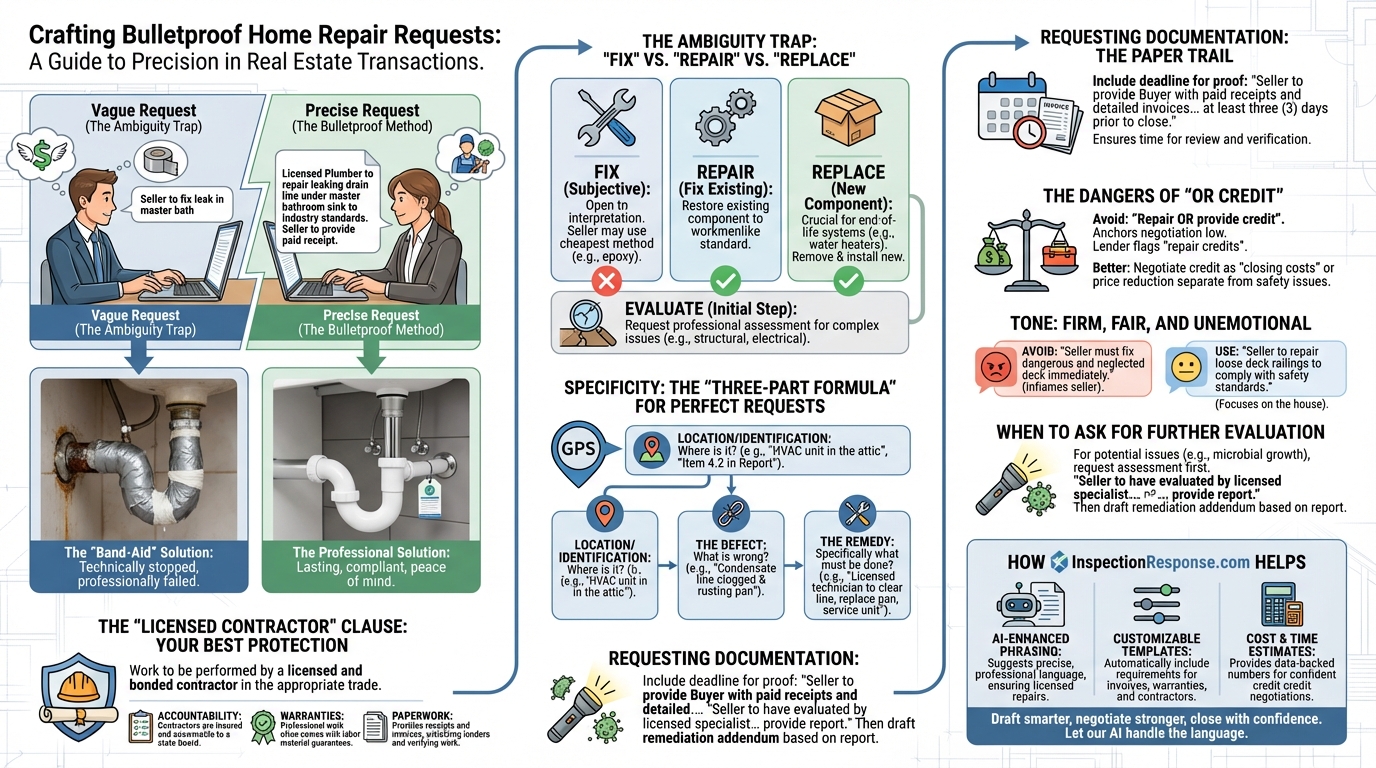
Imagine this scenario: A home inspection reveals a leaking pipe under the master bathroom sink. The buyer’s agent quickly types up a repair request stating, "Seller to fix leak in master bath." The seller agrees. A week before closing, the buyer does the final walk-through only to find that the seller wrapped the pipe in duct tape and slathered it in caulk. The leak has technically stopped, but the repair is unprofessional, temporary, and prone to failure.
Who is at fault? While the seller cut corners, the request itself left the door open for a "Band-Aid" solution.
In real estate transactions, the inspection response often called the BINSR (Buyer’s Inspection Notice and Seller’s Response) or Request for Repairs is a pivotal moment. It is where the physical reality of the home meets the contractual obligations of the deal. For real estate agents and homebuyers, the specific language used in this document is the difference between a professional, lasting repair and a post-closing nightmare.
In this guide, we will explore why vague requests kill deals, how to craft bulletproof repair addendums, and why precision is your best negotiation tool.
The Ambiguity Trap: "Fix" vs. "Repair" vs. "Replace"
The most common mistake in drafting inspection responses is using broad verbs that are open to interpretation. Words like "fix" or "address" are subjective. To a seller trying to save money, "fix" might mean a $5 tube of epoxy. To a buyer, "fix" implies a full restoration to industry standards.
To protect your client, you must be specific about the desired outcome.
- Repair: Implies fixing the existing component. This should always be paired with a standard of quality (e.g., "in a workmanlike manner").
- Replace: Implies removing the defective component and installing a new one. This is crucial for end-of-life systems like water heaters or HVAC units where a "repair" is merely delaying the inevitable.
- Evaluate: This requests that a licensed professional look at the issue to determine the scope of work. This is often a necessary first step for complex electrical or structural issues.
Key Takeaway: Never leave the definition of "done" up to the seller.
The "Licensed Contractor" Clause
Perhaps the single most important phrase to include in any repair request is: "Work to be performed by a licensed and bonded contractor in the appropriate trade."
Without this language, the seller is often within their rights to perform the repairs themselves or hire a generic handyman. While a handyman is great for hanging drywall, you generally do not want them rewiring a breaker panel or replacing a roof valley.
Why this language matters:
- Accountability: Licensed contractors carry insurance and are accountable to a state board.
- Warranties: Professional work usually comes with a warranty on labor and materials.
- Paperwork: Licensed pros provide receipts and invoices, which serve as proof that the work was done correctly. This is vital for the buyer’s peace of mind and for satisfying lender requirements.
Specificity in Identifying the Defect
A home inspection report might contain hundreds of items. When referencing a defect in your response, you cannot assume the seller remembers exactly which outlet had reversed polarity.
Effective response language acts like a GPS for the contractor. Instead of saying "Fix broken outlet," try:
"Replace the GFCI outlet located on the north wall of the kitchen counter (Item 4.2 in Inspection Report) that failed to trip when tested."
The "Three-Part Formula" for Perfect Requests:
- Location/Identification: Where is it? (e.g., "HVAC unit in the attic")
- The Defect: What is wrong? (e.g., "Condensate line is clogged and rusting the pan")
- The Remedy: What specifically must be done? (e.g., "Licensed HVAC technician to clear the line, replace the rusted pan, and service the unit to ensure proper operation.")
Requesting Receipts and Documentation
The language in your response shouldn't just cover the physical work; it must also cover the paper trail. A request is not complete without a deadline for proof.
Include language such as:
"Seller to provide Buyer with paid receipts and detailed invoices from licensed contractors describing the work performed at least three (3) days prior to the close of escrow."
This ensures the buyer's agent has time to review the work and verify the contractors used were legitimate before the final walk-through.
The Dangers of "Or Credit"
Sometimes, agents will write, "Seller to repair the roof OR provide a $2,000 credit." While this seems flexible, it psychologically anchors the negotiation. If the roof repair actually costs $5,000, you have just tipped your hand that your client is willing to settle for $2,000.
Furthermore, lender rules regarding credits in lieu of repairs can be strict. "Credits for repairs" are often flagged by underwriters. It is usually better to negotiate the credit as "closing costs" or a price reduction, keeping the language of the credit separate from the safety issues noted in the inspection. Language precision here prevents mortgage delays.
Tone: Firm, Fair, and unemotional
Inspection responses are business documents, not emotional vents. While a buyer might be angry that the seller hid a termite issue, the repair request is not the place to accuse them of fraud.
- Avoid: "Seller must fix the dangerous and neglected deck immediately."
- Use: "Seller to repair loose deck railings to comply with current safety standards."
Adjectives like "dangerous," "filthy," or "neglected" inflame the seller and make them defensive. Neutral, technical language focuses on the house, not the homeowner, making it easier for the seller to say "yes."
When to Ask for Further Evaluation
Sometimes, an inspector will flag a potential issue but state that it requires a specialist to determine the extent of the damage (e.g., "evidence of microbial growth"). In these cases, your language should not demand a repair yet.
Correct phrasing:
"Seller to have the crawlspace evaluated by a licensed mold remediation specialist to determine the source of moisture and extent of growth. Seller to provide a copy of the specialist's report to Buyer within 5 days."
Once you have the report, you can draft a second addendum for the actual remediation. Demanding a repair before you know the scope is a recipe for a dispute.
Conclusion
The home inspection response is the final hurdle in most real estate transactions. It is a moment where millions of dollars in assets and the safety of future occupants rely on the written word. By moving away from vague requests like "fix it" and adopting precise, professional language that demands licensed work and receipts, real estate agents can protect their clients from substandard repairs and post-closing liabilities.
Remember: The seller cannot agree to what you do not ask for. Ask clearly, ask correctly, and get the deal closed with confidence.
How InspectionResponse.com Can Help
Drafting the perfect repair request takes time and significant mental energy. You have to comb through a 50-page PDF, identify the critical issues, and then manually draft the legalistic language for each item to ensure your client is protected. This manual process is prone to errors and omissions.
InspectionResponse.com transforms this workflow. Our AI-driven platform analyzes the home inspection report for you. It automatically identifies the findings and allows you to generate a professional Repair Request Addendum in minutes, not hours.
Here is how we solve the "language problem":
- AI-Enhanced Phrasing: Our system suggests precise, professional language for every defect found in the report, ensuring you are asking for "licensed repairs" and "proper replacement" rather than vague fixes.
- Customizable Templates: You can set your preferences to automatically include requirements for invoices, warranties, and licensed contractors in every request you generate.
- Cost & Time Estimates: We provide data-backed estimates for repairs, empowering you to negotiate credits with accurate numbers rather than guesses.
Stop worrying about whether you worded the roof repair correctly. Let our intelligent system draft the response for you, so you can focus on managing your client and closing the deal.
Additional Resources
Briefing Document & Key Takeaways
Briefing: The Language of Real Estate Repair Demands
Executive Summary
The language used in real estate repair requests often called the Buyer’s Inspection Notice and Seller’s Response (BINSR) is a critical factor in protecting a homebuyer's interests and ensuring the integrity of a transaction. The use of vague, ambiguous terms like "fix" or "address" creates loopholes that sellers can exploit, resulting in substandard, "Band-Aid" repairs that fail post-closing. The central argument is that precision is the most effective negotiation tool.
Effective repair requests must be built on a foundation of specific, unemotional, and professional language. This involves replacing ambiguous verbs with explicit directives like "repair," "replace," or "evaluate," and always mandating that work be performed by a "licensed and bonded contractor." Furthermore, a robust request follows a three-part formula identifying the location, the defect, and the specific remedy and demands a paper trail of receipts and invoices to verify the work. Agents must also avoid common pitfalls, such as the "or credit" clause, which can weaken negotiating positions and trigger lender scrutiny. Ultimately, mastering this precise language transforms the inspection response from a point of conflict into a clear, contractual agreement that protects clients from future liabilities and ensures deals close with confidence.
The Critical Role of Language in Repair Requests
In any real estate transaction, the inspection response serves as the pivotal intersection of a home's physical condition and the deal's contractual obligations. The quality of the language in this document directly determines the quality of the repair. An imprecise request can lead to significant post-closing problems.
• The "Band-Aid" Repair Problem: A vague request like "Seller to fix leak in master bath" leaves the method and quality of the repair entirely to the seller's discretion. This can result in a temporary, unprofessional fix, such as using duct tape and caulk on a leaking pipe, which technically stops the leak but fails to provide a lasting solution.
• Contractual Loopholes: The buyer's agent in such a scenario is partially at fault for leaving the door open to an inadequate repair. The language of the request is the primary tool for closing these loopholes and ensuring a professional outcome.
The Ambiguity Trap: Defining the Desired Outcome
The most common error in drafting repair addendums is the use of broad verbs that are subjective and open to interpretation. Words like "fix" or "address" can mean a $5 tube of epoxy to a cost-conscious seller, while a buyer expects a full restoration to industry standards. To protect the buyer, the desired outcome must be explicitly defined.
• Repair: This term implies fixing an existing component. It should always be paired with a standard of quality, such as a requirement that the work be performed "in a workmanlike manner."
• Replace: This term is used to demand the removal of a defective component and the installation of a new one. It is essential for end-of-life systems, like an aging water heater or HVAC unit, where a simple repair would only delay an inevitable failure.
• Evaluate: This is a request for a licensed professional to assess an issue and determine the full scope of work required. It is a necessary first step for complex structural, electrical, or environmental concerns.
The key principle is to never leave the definition of "done" to the seller's interpretation.
Mandating Professional Standards: The "Licensed Contractor" Clause
Including the phrase, "Work to be performed by a licensed and bonded contractor in the appropriate trade," is arguably the single most important element of any repair request. Without this clause, sellers are often within their rights to perform repairs themselves or hire an inexpensive handyman, which is inappropriate for specialized work like electrical wiring or roofing.
This specific language provides critical protections:
• Accountability: Licensed contractors are insured and accountable to a state licensing board, providing a mechanism for recourse if the work is substandard.
• Warranties: Professional work typically includes warranties on both labor and materials, offering the buyer long-term protection.
• Paperwork: Licensed professionals provide official receipts and invoices that serve as proof of completed work, which is vital for the buyer's peace of mind and can be a requirement for mortgage lenders.
A Framework for Precision: The Three-Part Formula
An effective repair request acts as a clear set of instructions for the seller and their contractor. Vague references are insufficient. A perfect request is built using a simple, three-part formula.
1. Location/Identification: Pinpoint exactly where the issue is located, referencing the item number from the inspection report if possible (e.g., "the GFCI outlet located on the north wall of the kitchen counter (Item 4.2 in Inspection Report)").
2. The Defect: State clearly what is wrong with the component (e.g., "that failed to trip when tested").
3. The Remedy: Specify exactly what must be done to correct the defect (e.g., "Licensed HVAC technician to clear the line, replace the rusted pan, and service the unit to ensure proper operation.").
Ensuring Accountability Through Documentation
A repair request is incomplete without a requirement for documentation. The language must cover not only the physical work but also the paper trail that proves it was done correctly. This involves setting a clear deadline for the delivery of proof.
• Required Language: A request should include a clause such as: "Seller to provide Buyer with paid receipts and detailed invoices from licensed contractors describing the work performed at least three (3) days prior to the close of escrow."
• Purpose: This allows the buyer's agent sufficient time to review the documentation, verify the contractor's credentials, and confirm the scope of work before the final walk-through.
Strategic Negotiation and Lender Compliance
Certain common phrases used in repair requests can unintentionally undermine a buyer's position and create financing delays.
• The Dangers of "Or Credit": Language like, "Seller to repair the roof OR provide a $2,000 credit," is problematic. It psychologically anchors the negotiation to the credit amount, even if the actual repair cost is significantly higher (e.g., $5,000). The buyer's agent has tipped their hand that the client might settle for less.
• Lender Scrutiny: Mortgage underwriters often flag "credits for repairs," especially when tied to safety issues noted in an inspection. This can cause delays in loan approval. It is strategically better to negotiate a credit as a contribution to "closing costs" or as a general price reduction, keeping the language of the credit separate from the repair issues.
Maintaining a Professional and Unemotional Tone
The inspection response is a business document, not a forum for expressing frustration. The tone should remain firm, fair, and unemotional to facilitate a smooth negotiation.
• Avoid Inflammatory Language: Adjectives like "dangerous," "filthy," or "neglected" only serve to make the seller defensive and less likely to cooperate.
• Focus on Technical Facts: Instead of, "Seller must fix the dangerous and neglected deck immediately," a more effective request is, "Seller to repair loose deck railings to comply with current safety standards." This neutral language focuses on the property's condition rather than placing blame on the homeowner, making it easier for the seller to agree.
Addressing Complex Issues with Further Evaluation
When an inspector identifies a potential issue but recommends a specialist for a full diagnosis (e.g., "evidence of microbial growth"), the initial request should not be for a repair. Demanding a remedy before understanding the scope of the problem is a recipe for a dispute.
• Correct Phrasing: The request should be for an assessment first: "Seller to have the crawlspace evaluated by a licensed mold remediation specialist to determine the source of moisture and extent of growth. Seller to provide a copy of the specialist's report to Buyer within 5 days."
• Two-Step Process: Once the specialist's report is received, a second addendum can be drafted to address the specific remediation work required.
Technological Solutions for Crafting Repair Requests
The manual process of analyzing a lengthy inspection report and drafting legally precise language for each repair item is time-consuming and prone to human error. AI-driven platforms like InspectionResponse.com are emerging to solve this problem.
• Automated Workflow: These systems analyze the inspection report PDF, automatically identify findings, and help generate a professional repair addendum.
• AI-Enhanced Language: The platform suggests precise, professional phrasing for each defect, ensuring requests use terms like "licensed repair" and "proper replacement" instead of vague alternatives.
• Customization and Data: Users can set templates to automatically include clauses for licensed contractors and invoices. The system may also provide data-backed cost estimates to empower agents in negotiating credits.
• Core Benefit: This technology allows agents to offload the tedious drafting process, reduce the risk of errors and omissions, and focus on client management and negotiation.
Study Guide
Study Guide: The Language of Real Estate Repair Demands
Short-Answer Quiz
1. What is the "Ambiguity Trap" in the context of real estate repair requests, and why is the word "fix" a primary example of it?
2. What is the single most important phrase to include in a repair request, and what problem does it prevent?
3. What are the three key benefits of demanding that work be performed by a licensed contractor?
4. Identify and briefly describe the "Three-Part Formula" for crafting a perfect repair request.
5. Why is it crucial to request paid receipts and invoices from the seller, and when should they be provided?
6. Explain the two main dangers associated with using an "or credit" clause in a repair negotiation.
7. What kind of tone should be used in an inspection response, and what kind of language should be avoided?
8. When a home inspector identifies a potential issue but recommends a specialist, what is the correct immediate course of action in the repair request?
9. According to the source, how does the InspectionResponse.com platform solve the "language problem" for real estate agents?
10. Beyond the verb used, what other element of specificity is required to create an effective request that acts like a "GPS for the contractor"?
Quiz Answer Key
1. The "Ambiguity Trap" refers to using broad, subjective verbs like "fix" or "address" that are open to interpretation. The word "fix" is a primary example because it can mean a cheap, temporary solution (like duct tape) to a seller, while a buyer expects a full restoration to professional, industry standards.
2. The most important phrase is: "Work to be performed by a licensed and bonded contractor in the appropriate trade." Including this language prevents the seller from performing the repairs themselves or hiring a generic, unqualified handyman for specialized jobs like electrical or roofing work.
3. The three key benefits are accountability, warranties, and paperwork. Licensed contractors are accountable to a state board and carry insurance; their work often comes with a warranty on labor and materials; and they provide official receipts and invoices that serve as proof the work was completed correctly.
4. The "Three-Part Formula" for a perfect request consists of: 1) Location/Identification, which specifies where the issue is; 2) The Defect, which describes what is wrong; and 3) The Remedy, which details what specific work must be done by a qualified professional.
5. Requesting paid receipts and invoices provides proof that the work was completed by legitimate, licensed professionals. This documentation should be provided to the buyer at least three days prior to the close of escrow to allow time for review and verification before the final walk-through.
6. First, an "or credit" clause psychologically anchors the negotiation to the credit amount, even if the actual repair costs more. Second, credits specifically labeled "for repairs" can be flagged by mortgage underwriters, potentially causing delays in the lending process.
7. The tone of an inspection response should be firm, fair, and unemotional, focusing on the house rather than the homeowner. Adjectives that inflame the seller, such as "dangerous," "filthy," or "neglected," should be avoided in favor of neutral, technical language.
8. The correct course of action is not to demand a repair, but to request further evaluation. The language should require the seller to have the issue evaluated by a licensed specialist in the relevant field (e.g., mold remediation) and to provide a copy of the specialist's report to the buyer.
9. InspectionResponse.com solves the language problem by using its AI-driven platform to analyze the inspection report. It then suggests precise, professional phrasing for each defect, incorporates customizable templates that automatically include requirements for licensed contractors and invoices, and provides data-backed cost estimates for repairs.
10. To be effective, the request must specifically identify the defect's location and reference its corresponding item number in the inspection report. For example, instead of "Fix broken outlet," one should specify, "Replace the GFCI outlet located on the north wall of the kitchen counter (Item 4.2 in Inspection Report)."
Essay Questions
1. Discuss the pivotal role of the Buyer’s Inspection Notice and Seller’s Response (BINSR) in a real estate transaction. Explain how the specific language used within this document can determine the difference between a professional, lasting repair and a post-closing liability for the buyer.
2. Analyze the strategic differences between the verbs "repair," "replace," and "evaluate." Provide a hypothetical scenario for each term where its specific use would be the most appropriate and effective choice in protecting the buyer's interests.
3. Explain how the combination of the "licensed contractor" clause, the "Three-Part Formula," and the demand for documentation creates a "bulletproof" repair addendum. Describe how these three elements work together to leave no room for misinterpretation by the seller.
4. Explore the argument that the tone of a repair request is a critical negotiation tool. Why does using neutral, technical language often lead to better outcomes than using emotional or accusatory language, and how does this approach facilitate a seller's agreement?
5. Describe the problems that the InspectionResponse.com platform is designed to solve. How does its AI-driven workflow address the common errors and challenges real estate agents face when manually drafting repair requests?
Glossary of Key Terms
• Ambiguity Trap: The common error of using broad, subjective verbs in a repair request (such as "fix" or "address") that are open to interpretation and can result in substandard repairs.
• BINSR (Buyer’s Inspection Notice and Seller’s Response): A pivotal contractual document in a real estate transaction where the buyer formally communicates inspection findings and repair demands to the seller.
• Evaluate: A type of repair request that asks for a licensed professional to assess a complex issue (e.g., structural, electrical) to determine the full scope of the problem before a specific remedy is requested.
• Fix: A vague, subjective verb often used in repair requests that is strongly discouraged. It can be interpreted by a seller as a cheap, temporary patch rather than a professional, lasting repair.
• InspectionResponse.com: An AI-driven platform designed to help real estate agents by analyzing inspection reports and automatically generating precise, professional repair request addendums.
• Licensed and Bonded Contractor: A professional who is accountable to a state board, carries insurance, and typically provides warranties for their work. Demanding their use is a key clause for ensuring quality repairs.
• "Or Credit" Clause: A negotiation tactic in a repair request that offers the seller the choice between performing a repair or providing a monetary credit. This is discouraged as it can anchor negotiations to a low number and cause lender issues.
• Replace: A specific verb used in a repair request implying the complete removal of a defective component and the installation of a new one, crucial for end-of-life systems like water heaters or HVAC units.
• Repair: A verb used in a request that implies fixing an existing component. It should always be paired with a standard of quality, such as "in a workmanlike manner."
• Request for Repairs: A general term for the addendum or notice (such as a BINSR) where a buyer outlines the repairs they are requesting the seller to complete based on the findings of a home inspection.
• Three-Part Formula: A method for drafting perfect repair requests by including three key pieces of information: the Location/Identification of the issue, a description of the Defect, and the specific Remedy required.
Frequently Asked Questions
1. Why is the specific language in a repair request so critical for a real estate transaction?
The language used in a repair request addendum is not just a suggestion; it is a contractual instruction that directly defines the standard of quality for the work to be performed. Ambiguity at this stage is the leading cause of disputes, closing delays, and post-closing liabilities. Vague terms create loopholes that a seller can exploit, often unintentionally, to deliver a solution that is technically compliant but professionally substandard.
Consider the common scenario of a leaking pipe discovered during an inspection. A buyer's agent drafts a seemingly straightforward request: "Seller to fix leak in master bath." The seller agrees. At the final walk-through, the buyer discovers the "fix" consists of duct tape and caulk. While the leak has temporarily stopped, the solution is unprofessional and destined to fail. Because the agent's vague request failed to specify a professional standard, the seller was able to deliver a 'fix' that was contractually compliant yet professionally unacceptable. The agent's language created a legally defensible loophole for a substandard repair.
Ultimately, the specificity of the language is the primary tool an agent has to protect their client from amateur work and future problems. It transforms a potential point of conflict into a clear, non-negotiable contractual requirement. The words you choose determine the quality of the outcome, which is why understanding the specific terms that cause these issues is so vital.
2. What's the difference between "fix," "repair," and "replace," and why does it matter?
The verbs used in a repair request are not interchangeable, and selecting the correct one is fundamental to achieving your buyer's desired outcome. Each word carries a different weight and implies a different scope of work. Understanding these distinctions is the first step toward eliminating costly assumptions and ensuring the seller’s obligation aligns with the buyer’s expectation.
• "Fix" or "Address": These are subjective, ambiguous terms that should be avoided. They leave the definition of "done" entirely open to the seller's interpretation, which often results in the most minimal-effort, low-cost solution possible.
• "Repair": This term implies that the existing defective component will be restored to proper function. It is a more precise term than "fix," but it must be qualified with a standard of quality, such as specifying that the work be done "in a workmanlike manner" by a qualified professional.
• "Replace": This is the most specific term, indicating the complete removal of a defective component and the installation of a new one. It is the appropriate choice for end-of-life systems, such as a failing water heater, where a simple repair would only delay an inevitable and more costly failure.
• "Evaluate": This is a strategic request for a professional diagnosis. It is the necessary first step for complex or potentially serious issues, such as structural cracks, electrical faults, or evidence of microbial growth, where the full scope of the problem is not yet known.
The goal is to remove all subjectivity from the request. Never leave the definition of a completed repair up to the seller's discretion or financial convenience. To remove all subjectivity and guarantee a professional outcome, one clause must be central to every repair request you write.
3. What is the single most important clause to include in any repair request to ensure quality work?
The "licensed contractor" clause is the ultimate safeguard against amateur, DIY, or handyman repairs that may not meet professional standards. Its inclusion is a strategic move that elevates the entire repair agreement by setting a non-negotiable benchmark for the quality and legitimacy of all work performed. This single phrase closes the most common loophole sellers use to cut costs.
The essential language to include is: "Work to be performed by a licensed and bonded contractor in the appropriate trade."
The importance of this clause cannot be overstated and provides three primary benefits for your client:
• Accountability: Licensed contractors carry insurance and are accountable to a state licensing board. This provides a clear path for recourse if the work is performed improperly.
• Warranties: Professional work from a licensed contractor typically includes warranties on both labor and materials, offering the new homeowner long-term protection that a handyman repair does not.
• Paperwork: Licensed professionals provide detailed invoices and receipts. This documentation is crucial evidence that the work was completed as agreed upon, satisfying both the buyer and their lender.
Once you have established the standard for who will do the work, the next step is to provide them with precise instructions on what to do.
4. How can I write a repair request that leaves no room for misunderstanding?
Beyond specifying the quality of the work, an effective request must precisely identify the location and nature of the defect. A well-written addendum acts as a clear and unambiguous set of instructions for the seller and their chosen contractor, eliminating any guesswork. A vague request leads to a vague repair.
For example, contrast this ineffective request:
"Fix broken outlet."
With this effective, professional request:
"Replace the GFCI outlet located on the north wall of the kitchen counter (Item 4.2 in Inspection Report) that failed to trip when tested."
The second example is superior because it follows a clear, repeatable formula that leaves no room for error.
A Three-Part Formula for Precision
1. Location/Identification: State exactly where the issue is located. Referencing the item number from the inspection report adds another layer of precision. For example, "HVAC unit in the attic."
2. The Defect: State clearly what is wrong with the component, using language from the inspection report. For example, "Condensate line is clogged and rusting the pan."
3. The Remedy: State what specifically must be done to correct the issue, including the standard of work. For example, "Licensed HVAC technician to clear the clogged condensate line, replace the rusted pan, and service the unit to ensure proper and safe operation."
Following this formula ensures your request is a precise directive, not a vague suggestion. But the work isn't done until you have the paperwork to prove it.
5. Beyond the physical work, what documentation must be requested to verify repairs?
A repair request is incomplete if it only addresses the physical labor. The demand for a "paper trail" is just as critical as the demand for a licensed contractor. This documentation serves as the legal and practical proof that the work was completed to the standard agreed upon in the addendum. Without it, you are relying solely on visual confirmation during a brief walk-through.
To ensure this proof is delivered in a timely manner, include a specific clause that sets a deadline for receipt. A model phrasing is: "Seller to provide Buyer with paid receipts and detailed invoices from licensed contractors describing the work performed at least three (3) days prior to the close of escrow."
The strategic value of this clause is immense. It provides the buyer's agent with the necessary time to review the documentation before the final walk-through. This allows you to verify the contractor's credentials, confirm the scope of work described on the invoice matches the request, and address any discrepancies without the pressure of a last-minute, pre-closing crisis.
6. What are the hidden dangers of offering an "or credit" option in a repair negotiation?
The "or credit" clause (e.g., "Seller to repair the roof OR provide a $2,000 credit") is a common negotiation tactic that seems to offer flexibility but is strategically flawed. While intended to open a dialogue, this language can inadvertently weaken your client's position and create logistical hurdles.
There are two primary risks associated with this approach:
1. Psychologically Anchors the Negotiation: By offering a specific credit amount upfront, you have tipped your hand and signaled that your client is willing to accept that figure. If subsequent quotes reveal the actual repair cost is significantly higher for example, $5,000 you have already psychologically anchored the negotiation around the lower number, making it much harder to secure the full amount.
2. Creates Lender Complications: Mortgage underwriters often flag "credits for repairs." This language can trigger additional scrutiny, require contractor bids, and potentially delay the mortgage approval process. A much safer strategy is to negotiate credits separately as "closing costs" or as a direct price reduction, which are standard financial adjustments that prevent the underwriting red flags and mortgage delays that 'credits for repairs' can trigger.
While tempting, the "or credit" language can undermine your negotiating power and introduce unnecessary friction with the lender. It is far better to treat repairs and financial concessions as two distinct negotiation paths. Just as financial language requires precision, so too do requests for issues where the full scope of the problem is still unknown.
7. How should I handle requests for complex issues like potential mold or structural problems?
It is common for a home inspector to identify a potential major issue such as evidence of moisture intrusion, microbial growth, or a structural crack but recommend further evaluation by a specialist. In these situations, the initial repair request should not be for a repair at all, but for a professional diagnosis. Demanding a remedy before understanding the full scope of the problem is a recipe for a dispute.
The incorrect approach is to demand a "fix" for an unknown problem. The proper method is a two-step process that begins with a request for information.
Use clear, diagnostic language like this example for potential microbial growth: "Seller to have the crawlspace evaluated by a licensed mold remediation specialist to determine the source of moisture and extent of growth. Seller to provide a copy of the specialist's report to Buyer within 5 days."
This phrasing accomplishes two key goals: it compels the seller to hire an expert to define the problem, and it ensures the buyer receives a copy of that expert's report. Once that report is received, a second addendum can be drafted with surgical precision, addressing the specific remediation work and costs outlined by the specialist. This process replaces guesswork with expert data, leading to a fair and durable resolution. This data-driven approach is effective precisely because it remains objective, which underscores the importance of the overall tone of your request.
8. What is the proper tone for a repair request, and how can it impact negotiations?
A repair request addendum is a business document, not an emotional outlet. The tone should always be firm, fair, and unemotional. While a buyer may feel frustrated or angry about the condition of a property, allowing that emotion to seep into the written request can be highly counterproductive. An accusatory or demanding tone can immediately make a seller defensive, transforming a logistical negotiation into a personal conflict.
Contrast the tone of these two examples:
• Avoid: "Seller must fix the dangerous and neglected deck immediately."
• Use: "Seller to repair loose deck railings to comply with current safety standards."
Inflammatory adjectives like "dangerous," "filthy," or "neglected" serve no purpose other than to antagonize the seller. By using neutral, technical language, you focus the negotiation on the objective condition of the property, not the subjective character of the homeowner. This professional approach makes it far easier for the seller to agree to the requested repairs without feeling personally attacked, increasing the likelihood of a successful negotiation.