Restoring a Wood Deck: A Real Estate Agent's Field Guide to Inspection Findings and Repair Requests
Podcast Overview
A wood deck is often the most photographed feature of a listing and the most defect-laden item in the inspection report. Buyers see the entertaining space; the inspector sees the rot pockets, loose ledger bolts, and undersized footings. As the agent in the middle, you need a working framework for what "restoration" actually means, what an inspector will and will not flag, and how to convert those findings into clear repair language without overreaching.
This guide breaks down deck restoration the way a working buyer's agent should think about it: surface condition, structural integrity, code and safety, and the conversation you will have with both the listing side and your own client.
Why Deck Condition Drives Negotiation
Decks sit in a difficult negotiation zone. They are often older than the rest of the house because owners build them after move-in. They are exposed to weather year round. They show wear cosmetically long before they fail structurally, and they can fail structurally without showing much at all. The result is that decks generate a disproportionate share of inspection findings relative to their square footage.
A deck in poor condition affects the deal in three ways. It signals deferred maintenance to the buyer, which colors how they read the rest of the report. It can trigger lender concerns when ledger attachments or guard rails are clearly substandard. And it represents real money: a full restoration runs in the low thousands; a tear-down and rebuild on the same footprint can run into five figures depending on size, material, and local labor rates. Knowing where on that spectrum a given deck falls is the difference between a clean repair request and a stalled transaction.
What "Restoration" Actually Covers
When agents and clients say "restore the deck," they usually mean cosmetic work: pressure washing, sanding, replacing a few warped boards, and re-staining or re-sealing. That is restoration in the consumer sense. From an inspection standpoint, restoration is broader. It includes anything that returns the deck to safe, durable, code-compliant service without a full rebuild.
A useful breakdown is three layers.
Surface condition. Pressure washing, brightener treatment, sanding rough boards, replacing splintered or cupped boards, and applying a fresh penetrating stain or sealer. Surface work is largely cosmetic, but it also slows the water intrusion that drives the next layer of problems.
Structural integrity. Joist condition, ledger board attachment, post bases, beam connections, fasteners, hardware corrosion, and footing depth. This is where serious money lives and where inspectors focus their flags. Nothing on the surface matters if a joist is rotted through at the ledger.
Code and safety. Guard rail height (typically 36 inches for residential, 42 in some jurisdictions), baluster spacing (the 4 inch sphere rule), stair rise and run consistency, graspable handrails, and lighting. These items are non-negotiable from a buyer-safety perspective and are often the first thing a buyer's agent should request.
The Inspection Findings You Will See Most Often
Even before you read the report, you can predict roughly 80 percent of what an inspector will flag on a 15 to 25 year old deck.
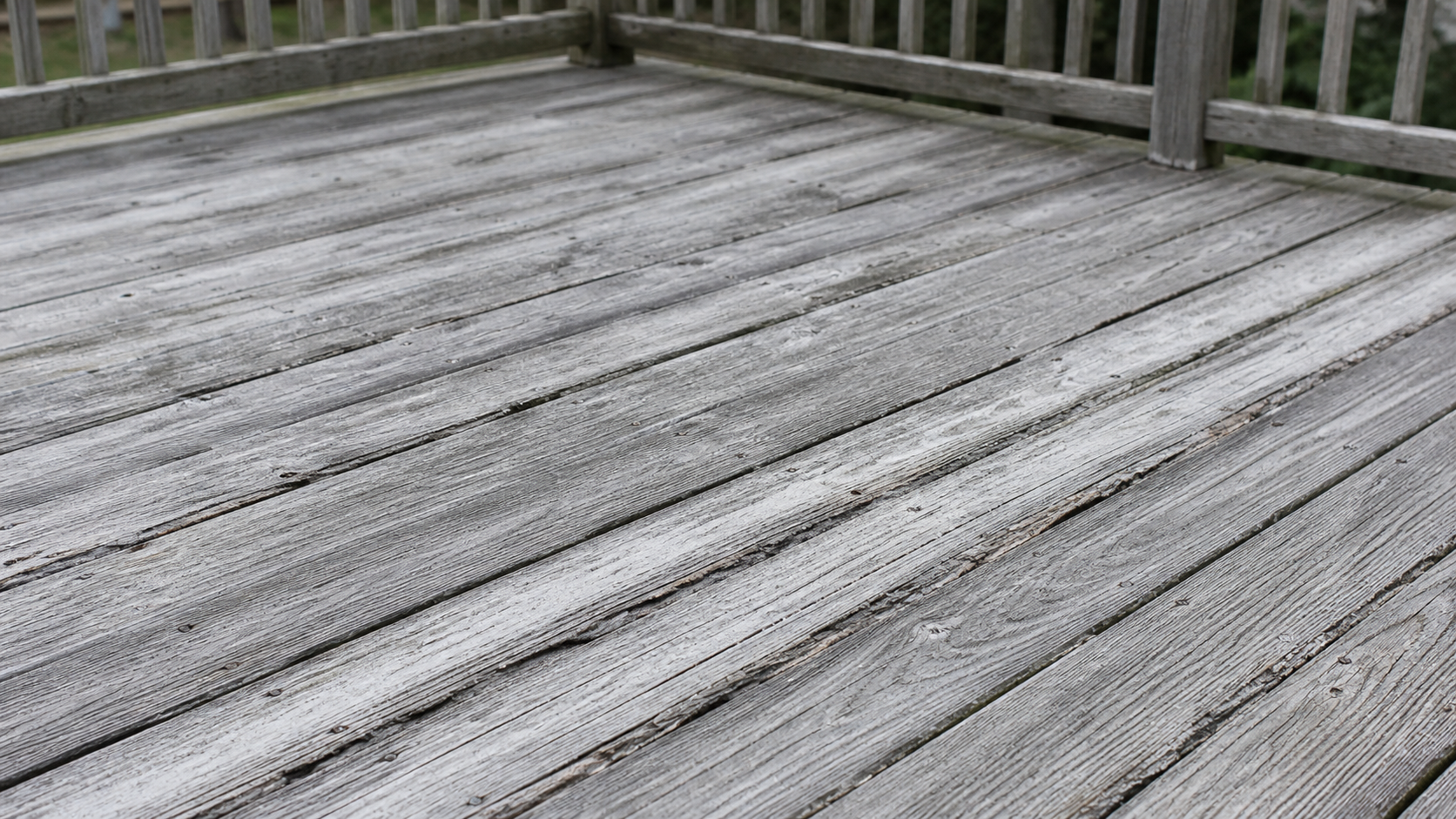
On the surface side: graying or fuzzing of board faces from UV exposure, peeling stain or paint, splinters, cupped or warped boards, popped fasteners, and gaps between boards that are too wide or too narrow.
On the structural side: lag bolts versus through-bolts at the ledger, missing or rotted ledger flashing, joist hangers fastened with roofing nails instead of structural connector screws, joists with notch damage at the bearing point, beam splices that do not land over a post, and posts that sit directly on concrete without a standoff bracket.
On the code and safety side: guards under 36 inches, balusters spaced to allow a 4 inch sphere through, stair stringers with inconsistent rise, missing handrails on stairs of four risers or more, and non-graspable handrail profiles.
A meaningful percentage of the findings will be flagged "for review by a licensed contractor" rather than called out as definitive defects. Treat those flags as triggers for a contractor quote, not as ignorable hedges.
The Restoration Versus Replacement Decision
This is the call that determines whether you are asking the seller for a repair or asking for a credit toward a rebuild. A few signals push toward replacement: framing has widespread rot rather than localized damage; ledger flashing is missing and the rim joist behind it shows decay; the deck is more than 20 to 25 years old and was built with construction practices that pre-date current code (single 2x6 joists at 24 inch on center, cantilevers beyond modern allowable limits, undersized footings); two or more posts are unbraced or sit on grade; or the substructure is older pressure-treated wood showing fastener corrosion consistent with the pre-2003 ACQ chemistry interaction.
Restoration, with surgical structural repairs, is appropriate when the framing is sound, the ledger is properly flashed and bolted, hardware is intact, and the issues are concentrated at the surface and at a few replaceable components.
How to Draft the Repair Request
The strongest repair request on a deck does three things. It separates surface work from structural work. It cites the report page so the listing side cannot claim a finding is invented. And it asks for licensed completion with documentation, not a verbal promise.
A clean structural ask reads something like: "Buyer requests that seller, at seller's expense, retain a licensed general contractor to repair the deck ledger attachment and replace damaged joists as identified on pages 34 to 36 of the inspection report. Repairs to be completed prior to closing with a copy of the contractor's invoice and any required permit provided to buyer."
A clean surface ask reads more directly: "Buyer requests that seller pressure wash, sand, and apply a penetrating stain or sealer to the rear deck surface and railings prior to closing, or provide a credit of $X based on local contractor estimates."
Avoid combining structural and cosmetic items in a single request. They have different price points, different urgency, and different acceptable resolutions. Listing agents will often trade you a credit on cosmetics in exchange for resisting a structural repair, and a single combined ask makes that trade harder to track.
What Listing Agents Will Push Back On
Listing-side pushback on deck items is predictable. Expect three patterns.
Ledger and structural items get characterized as "the deck has stood for 20 years, so it is fine." The response is that age does not equal compliance and that any future mortgage, insurance, or resale event can resurface the issue.
Surface items get characterized as "normal wear for a deck this age." That framing is sometimes fair; the response is to provide a contractor estimate and ask for a credit rather than physical work, which is faster for everyone and lets the buyer choose color and contractor.
Code items get characterized as "grandfathered." Most jurisdictions do not grandfather guard height or baluster spacing once a permit is pulled for any related work. If the deck is being repaired, the code items typically have to come along for the ride.
Common Misconceptions Worth Correcting
A few client-facing assumptions cause more grief than they should.
A new coat of stain does not solve a structural problem. It hides one. Recommend stain only after structural items have been resolved or estimated.
Composite decking does not eliminate inspection findings. The framing underneath is still wood, and the same ledger, joist, and hardware issues apply.
Pressure-treated lumber is not maintenance-free. Modern ACQ lumber needs the same UV protection as cedar to slow checking and graying.
A deck "passing inspection" is not a thing. Inspectors document condition; they do not pass or fail decks. A buyer's agent decides what gets included in the response.
Timing: Before Versus After Closing
For structural repairs, push hard for completion before closing with documentation in hand. The buyer's lender may require it, and the buyer has limited recourse against the seller after closing for a repair that was promised but not done. For cosmetic restoration, a credit at closing is often the cleaner path. The buyer can choose contractor, color, and timing without renegotiating mid-deal.
Where the Workflow Comes Together
Pulling deck items out of a 60 page report, separating cosmetic from structural, drafting clean request language, and tying each item to a specific page reference is the part of the job that eats hours. InspectionResponse handles that work directly: the agent uploads the inspection PDF, the platform identifies deck-related findings, prioritizes them by safety and severity, drafts professional repair request language, and links each item to the exact page in the original report so the listing side has nowhere to argue. The agent reviews, edits, and sends.
That is the leverage point on deck items specifically: not having an opinion about restoration, but having a clean, page-anchored, professionally worded request in the seller's hands within a day of receiving the report.
Additional Resources
Briefing Document & Key Takeaways
Title: Restoring a Wood Deck: Field Briefing for Agents
Audience: Residential real estate buyer's agents, listing agents anticipating buyer responses, transaction coordinators, and brokers training newer agents on inspection negotiation.
Purpose: Give the agent a working mental model for evaluating deck findings in a residential inspection report, separating cosmetic restoration from structural repair, and translating both into clean repair request language that holds up against listing-side pushback.
Key takeaways:
- Deck findings sort into three layers: surface, structural, and code/safety. Treat each layer separately in the repair request.
- Restoration is appropriate when framing, ledger, and hardware are sound and issues are concentrated at the surface. Replacement is appropriate when rot is widespread, the ledger system is failing, or the deck pre-dates current construction practices.
- The strongest repair request cites a specific report page, asks for licensed completion with documentation, and never bundles cosmetic and structural items in a single ask.
- Listing-side pushback follows three predictable patterns (it has stood for 20 years, normal wear, grandfathered code). Each has a clean response.
- Push for structural repairs to be completed before closing. Take a credit on cosmetic restoration so the buyer keeps control of color, contractor, and timing.
Recommended use: Read before drafting a repair request on any transaction where the inspection report contains more than two deck-related findings. Share relevant sections with the buyer to set expectations before the inspection conversation. Reference during listing-side negotiation when pushback follows the predictable patterns above.
Study Guide
This study guide is intended for agents new to inspection negotiation and as an internal training resource on deck-related findings.
Section 1: Surface vs Structural
- What three layers do deck inspection findings sort into?
- Why is it important to separate cosmetic items from structural items in a repair request?
- Which layer is most likely to be flagged "for review by a licensed contractor"?
Section 2: Reading the Inspection Report
- List four common surface-level findings on a 15 to 25 year old wood deck.
- List four common structural findings at the ledger or joist level.
- What does it mean when an inspector flags an item for licensed contractor review?
Section 3: Restoration Versus Replacement
- Name three signals that push the decision toward full deck replacement rather than restoration.
- Under what conditions is restoration with surgical structural repairs the right call?
- Why does the age and chemistry of pressure-treated lumber matter to the decision?
Section 4: Repair Request Strategy
- What three elements does a strong deck repair request always include?
- Why should structural and cosmetic items not be combined in a single repair request?
- When should the agent ask for a credit instead of physical repair?
Section 5: Listing-Side Pushback
- What is the standard listing-side response to a structural ledger finding, and how should the buyer's agent respond?
- What does the term "grandfathered" usually mean in a deck pushback, and is it usually accurate?
- Why is the timing of repairs (before versus after closing) different for structural items than for cosmetic items?
Application Exercise
You receive an inspection report on a 22 year old single-family home with a 12 by 16 foot rear deck. The inspector flags: (1) graying and splintered surface boards, (2) ledger attached with lag bolts and no flashing visible, (3) one rotted joist at the southwest corner, (4) guard rail measured at 32 inches, and (5) baluster spacing wide enough to pass a 4 inch sphere. Draft a repair request that separates the items appropriately, decides which are credit-worthy versus completion-required, cites pages, and anticipates listing-side pushback.
Answer Key
Section 1: Surface vs Structural
- Surface condition, structural integrity, and code and safety.
- Cosmetic and structural items have different price points, different urgency, and different acceptable resolutions; bundling them lets the listing side trade a cosmetic credit for resistance on the structural item.
- Structural items are most often flagged for licensed contractor review because diagnosing the extent of rot, fastener failure, or hidden damage is outside the scope of a general home inspection.
Section 2: Reading the Inspection Report
- Graying or UV fuzzing of boards, peeling stain or paint, cupped or warped boards, popped fasteners (also acceptable: splinters, gaps between boards too wide or too narrow).
- Lag bolts instead of through-bolts at the ledger, missing or rotted ledger flashing, joist hangers fastened with roofing nails, posts sitting directly on concrete without a standoff bracket (also acceptable: rotted joists, beam splices not over a post, undersized footings).
- The finding warrants further evaluation by a trade specialist before a final repair scope and price can be determined. Treat it as a trigger for a quote, not as an optional item.
Section 3: Restoration Versus Replacement
- Widespread (not localized) rot in the framing; missing ledger flashing combined with rim joist decay; deck older than 20 to 25 years built to outdated practices (also acceptable: multiple unbraced posts, pre-2003 pressure-treated lumber with corroded fasteners).
- When the framing is sound, the ledger is properly flashed and bolted, hardware is intact, and findings are concentrated at the surface plus a few replaceable components.
- Pre-2003 ACQ-treated lumber interacts with older fastener metallurgy and tends to corrode galvanized hardware faster than modern equivalents, which raises the structural risk profile of older decks.
Section 4: Repair Request Strategy
- It separates surface work from structural work, cites the specific report page, and asks for licensed completion with documentation.
- They have different price points, different urgency, and different acceptable resolutions; combining them makes it easier for the listing side to trade a cosmetic credit for resistance on the structural item and harder for the buyer's agent to track.
- When the work is cosmetic and the buyer would benefit from controlling color, contractor, and timing, or when the seller has limited time before closing and would otherwise rush the work.
Section 5: Listing-Side Pushback
- The standard response is "the deck has stood for 20 years, so it is fine." The buyer's agent responds that age does not equal compliance and that any future mortgage, insurance, or resale event can resurface the issue.
- "Grandfathered" usually claims that the deck is exempt from current code because of its age. In most jurisdictions, guard height and baluster spacing are not grandfathered once any related permit is pulled, so the claim is usually inaccurate when repair work is involved.
- Structural items affect lender approval and have limited recourse after closing, so they should be completed and documented before closing. Cosmetic items are easier to resolve through a credit at closing because the buyer keeps control of color, contractor, and timing.
Application Exercise (sample answer)
Draft two separate requests. First, a structural and code request for completion before closing: retain a licensed general contractor to (a) properly flash and through-bolt the deck ledger as identified on the inspection page noting the deficiency, (b) replace the rotted joist at the southwest corner per inspection report, (c) raise guard rail to a minimum of 36 inches, and (d) reduce baluster spacing so a 4 inch sphere cannot pass. Provide invoice and any required permit prior to closing. Second, a cosmetic credit request: provide a credit of $X (supported by local contractor estimate) toward pressure washing, sanding, and resealing the deck surface and railings. Anticipate pushback that the deck has stood for years and that surface wear is normal; respond with the contractor estimate for the surface work and the safety standard for the rail and baluster items.
Glossary of Key Terms
- ACQ (Alkaline Copper Quaternary): The chemistry used in pressure-treated lumber after the 2003 phase-out of CCA; more corrosive to standard galvanized fasteners than CCA was.
- Baluster: The vertical members of a guard rail, typically spaced so that a 4 inch sphere cannot pass between them.
- Beam: The horizontal structural member that carries the joists and transfers load to the posts.
- Cantilever: A section of joist that extends past the supporting beam without a post beneath the end.
- Cedar: A naturally rot-resistant softwood commonly used for deck surface boards and railings.
- Composite decking: Surface boards made from a mix of wood fiber and plastic; reduces surface maintenance but does not affect framing or structural inspection items.
- Cup (of a board): A board that has curled across its width, creating a concave or convex surface profile.
- Drip edge / kickout flashing: Sheet metal flashing that directs water away from the wall at a roof-to-wall or deck-to-wall junction.
- Fastener: Any nail, screw, bolt, or connector used to attach deck components.
- Flashing: Metal sheet material installed to direct water away from a vulnerable joint such as the deck ledger.
- Footing: The poured concrete pad or pier beneath a deck post that transfers load to undisturbed soil.
- Graspable handrail: A handrail with a profile that can be fully wrapped by the hand, required on stairs of four or more risers in most jurisdictions.
- Guard rail: The protective rail along the open edges of a deck, typically required at 36 inches in residential applications.
- Joist: The horizontal framing member that supports the deck surface boards.
- Joist hanger: A metal connector that holds the end of a joist to a ledger or beam; must be fastened with structural connector screws or nails, not roofing nails.
- Lag bolt: A heavy threaded screw with a hex head, sometimes used at the ledger but generally inferior to through-bolts for ledger attachment.
- Ledger board: The horizontal board attached to the house that supports one end of the deck joists.
- Penetrating stain or sealer: A finish that soaks into the wood surface rather than forming a film, slowing water intrusion and UV damage.
- Post base / standoff bracket: A metal bracket that elevates a post above its concrete footing to prevent end-grain water absorption and rot.
- Pressure-treated lumber: Wood chemically treated to resist rot and insects, used for the substructure of most modern decks.
- Rim joist: The outermost framing member that ties the joist ends together along the perimeter of the deck.
- Rise (stair): The vertical distance from one stair tread to the next; must be consistent to meet code.
- Run (stair): The horizontal depth of a stair tread.
- Sphere rule (4 inch): The code standard that requires baluster spacing tight enough to prevent a 4 inch sphere from passing through.
- Stringer: The diagonal structural board that supports the treads and risers of a stair.
- Through-bolt: A bolt that passes completely through the ledger and rim joist with a washer and nut on the back side; the preferred ledger attachment.
- UV oxidation: The silver-gray discoloration and fiber degradation that occurs on unfinished wood exposed to sunlight.
Frequently Asked Questions
What does "restoring a wood deck" actually include?
In the consumer sense, restoration means cosmetic work: pressure washing, sanding, replacing a few warped boards, and applying a fresh stain or sealer. From an inspection standpoint, restoration is broader and includes any work that returns the deck to safe, durable, code-compliant service without a full rebuild. That can mean surface refresh, structural repairs, and code corrections in combination.
How do home inspectors evaluate a wood deck?
Inspectors look at three layers: surface condition, structural integrity, and code and safety. They check ledger attachment, joist condition, post bases, hardware, fastener type, guard rail height, baluster spacing, stair geometry, and surface wear. Findings are documented with page references and severity language but are not graded as pass or fail.
Should I always request deck repairs after an inspection?
Not always. Surface wear on an older deck can reasonably be the buyer's ongoing maintenance, especially in a tight market. Structural and code-and-safety findings, though, are almost always worth requesting because they affect occupant safety, lender concerns, and the buyer's recourse after closing.
What is the difference between cosmetic and structural deck issues?
Cosmetic issues affect appearance and surface durability: graying boards, peeling stain, splinters, popped fasteners. Structural issues affect load capacity and life safety: failing ledger attachment, rotted joists, corroded hardware, post bases sitting on grade. The two should always be addressed in separate repair requests.
What deck issues are most likely to fail an inspection?
Inspectors do not technically pass or fail decks, but the most aggressive flags tend to land on ledger attachments fastened with lag bolts and no flashing, rotted joists or rim joists, joist hangers fastened with roofing nails, guard rails under 36 inches, and baluster spacing that allows a 4 inch sphere to pass. Any of these will typically be cited as a safety concern.
Can a buyer request a credit instead of physical deck repair?
Yes, and for cosmetic restoration a credit is often the cleaner path because the buyer keeps control of color, contractor, and timing. For structural items, push for completion before closing with documentation in hand because lender approval and post-closing recourse both favor completed work over a promise.
Are old decks "grandfathered" against current code?
Usually not when repair work is involved. Most jurisdictions do not grandfather guard height or baluster spacing once a permit is pulled for any related work, which means a structural repair on an older deck typically pulls code corrections along with it. Grandfathering is one of the most common, and most often inaccurate, listing-side pushback lines.
How much does it cost to restore a wood deck?
A surface restoration (pressure wash, sand, stain or seal, replace a few boards) typically runs in the low thousands depending on size and material. A full tear-down and rebuild on the same footprint can run into five figures depending on size, material choice, and local labor rates. Always pull a local contractor quote for the specific deck rather than relying on national averages.
What do listing agents typically push back on with deck repair requests?
Three patterns: ledger and structural items framed as "it has stood for 20 years, so it is fine," surface items framed as "normal wear for a deck this age," and code items framed as "grandfathered." Each has a clean response, and naming the pattern in advance helps the buyer's agent stay calm in the back-and-forth.
Should deck repairs be completed before closing?
Structural and code items, yes, with documentation. The buyer has limited recourse for a promised-but-not-done repair after closing, and lenders sometimes condition financing on safety items. Cosmetic restoration is often better handled with a closing credit so the buyer can choose contractor, color, and timing on their own schedule.